三世情缘
China’s market structure improves in H1 as AI, robots drive emerging industries_我的网站

A |
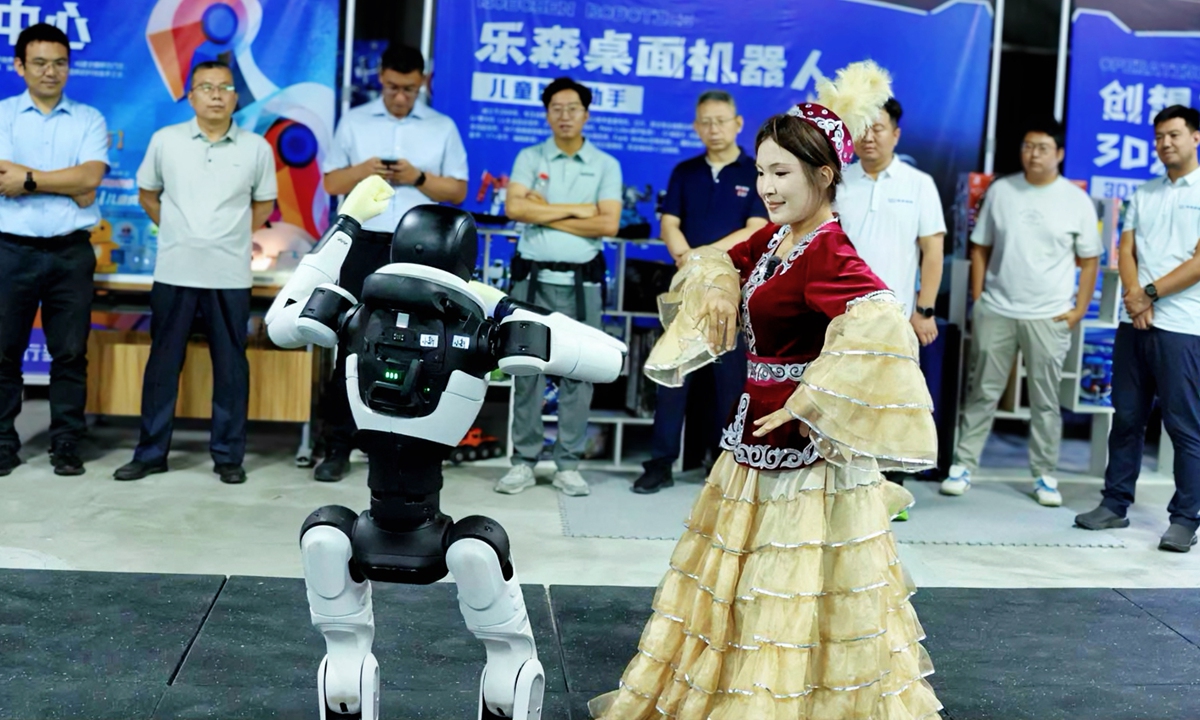
A Xinjiang local resident dances with a robot at the temporary exhibition hall at the region's first robotics 9S center on July 31, 2026. Photo: courtesy of the Xinjiang Future Era Information Technology Co, the operator of the project
China's market landscape experienced a structural optimization in the first half of 2026, powered by a lineup of emerging and future-oriented industries.
Official data from the State Administration for Market Regulation (SAMR) shows 561,000 new enterprises were registered across China's strategic emerging and future industries, spanning next-generation information technology, high-end equipment manufacturing, generative artificial intelligence (AI) and humanoid robotics.
The rapid expansion of these new market players is revamping China's industrial layout and fast-tracking the cultivation of new quality productive forces, underpinning steady high-quality economic upgrading, experts said.
Cutting-edge technology sectors stood out as the brightest growth spots, posting explosive year-on-year expansion. The generative AI industry recorded a 28 percent surge in new start-ups with 55,000 newly established firms, while the humanoid robot sector saw a 9.5 percent rise, adding 116,000 new enterprises.
"It shows that China's innovation momentum is exceptionally strong and remarkably broad-based — a trait that is virtually unique in the global landscape," Chen Jing, a vice president of the Technology and Strategy Research Institute, told the Global Times on Sunday. "The explosive growth of new enterprises in AI and robotics reflects the extraordinary depth and diversity of China's industrial ecosystem."
Outside high‑tech sectors, 3.957 million new services‑sector enterprises were established and booming emerging‑consumption businesses injected fresh impetus into domestic demand, the SAMR said.
The number of new firms in software and telecommunications services rose 3.3 percent to 322,000. Inspection‑and‑testing businesses soared 43.9 percent, and entities dedicated to the commercialization of scientific‑research achievements climbed 6.8 percent to 459,000.
Manufacturers accelerated industrial upgrading with companies moving up the value‑chain ladder, the SAMR said.
High‑end equipment industries have maintained growth during the first half, with 28,000 newly registered firms and a year‑on‑year increase of 2.5 percent.
A total of 330,000 high‑tech‑manufacturing enterprises were operating as of the end of June, including 15,000 newly established ones. Start‑ups engaged in the production of spacecraft and launch vehicles rocketed 185.7 percent. New producers of fiber optic cables climbed 129.4 percent and integrated‑circuit businesses increased by 24.2 percent.
"We are witnessing a dual-engine growth model, where new consumption in the services sector and high-tech services reinforce each other, while the digital and real economies integrate at an accelerating pace. At the same time, the intelligent transformation of manufacturing is picking up speed," Chen said.
The dividends from this industrial transformation are generating a powerful multiplier effect, creating a virtuous cycle led by innovation, Chen noted.
"The first‑half growth and structural shifts among China's market‑based businesses mirrored the country's overall economic momentum and industrial makeup. New‑emerging sectors, core strategic pillar industries and forward‑looking future industries registered the fastest business expansion," Tian Yun, a veteran economist, told the Global Times on Sunday.
These solid achievements fully reflect the success of China's innovation-driven economic strategy.
Strong policy support for specialized, sophisticated, unique and innovative enterprises has fueled this industrial boom while these market players have helped China shore up, upgrade and extend its industrial chains, Tian noted.
This business boom lines up with this year's stellar foreign trade figures, Tian noted.
China's exports rose 23.9 percent year-on-year in dollar terms in July, data from the General Administration of Customs showed on Friday.
Exports of high-tech products, including industrial robots and 3D printers, surged by more than 50 percent year-on-year, outpacing the 39 percent growth recorded in the first half of the year, according to the Xinhua News Agency.
The growing pool of high‑quality market players signaled lasting improvements in China's global competitiveness, industrial upgrading capacity and the standard of goods and services. Broader product ranges, better‑made commodities and improved supporting services will deliver durable new‑growth momentum, Tian noted.
。
NEW DELHI -- India’s top court on Tuesday refused to legalize same-sex marriages, passing the responsibility back to Parliament in a ruling that disappointed campaigners for LGBTQ+ rights in the world's most populous country. Chief Justice DY Chandrachud also urged the government to uphold the rights of the queer community and end discrimination against them. Earlier this year, the five-judge bench heard 21 petitions that sought to legalize same-sex marriage. Chandrachud said there were degrees of agreement and disagreement among the justices “on how far we have to go” on same-sex marriages, but a majority of the judges agreed that the court cannot grant LGBTQ+ people the right to marry as that is a legislative function. “This court can’t make law. It can only interpret it and give effect to it,” the chief justice said, reiterating that it was up to Parliament to decide whether it could expand marriage laws to include queer unions.One of the petitioners, Mario da Penha, said it was “a day to be disappointed but not to lose hope.”“There's been tremendous work that has gone into these petitions, and many hopes and dreams of the queer community attached to them - to lead lives that most other Indians take for granted. The fact that the dream could not come to fruition today is a disappointment for all of us,” he said.He added that it was not yet clear if the court had set a mandate or timeline for Parliament to act. “Without that mandate, there is no pressure on Parliament to enact any legislation.”“There are queer couples today that are already families and in relationships, and are pillars of society. That they are not afforded the dignity and rights that they are due is deeply disappointing,” said Karuna Nundy, one of the lawyers representing the petitioners. Legal rights for LGBTQ+ people in India have been expanding over the past decade, mostly as a result of the Supreme Court’s intervention. In 2018, the top court struck down a colonial-era law that had made gay sex punishable by up to 10 years in prison and expanded constitutional rights for the gay community. The decision was seen as a historic victory for LGBTQ rights, with one judge saying it would “pave the way for a better future."Despite this progress, Prime Minister Narendra Modi’s government resisted the legal recognition of same-sex marriage and rejected several petitions in favor. During the hearings, the government argued that a marriage is only between a biological male and a biological woman, adding that same-sex marriages went against religious values and that the petitions reflected only “urban elitist views”. Religious groups too had opposed same-sex unions, saying they went against Indian culture.Adish Aggarwala, the president of the Supreme Court bar association, said the court had done the right thing by recognizing that this was a job for Parliament, an argument the government also made during the hearings. Lawyers for the petitioners argued that marriage is between two people, not just a man and woman. They said concepts of marriage have gradually changed with time and laws should acknowledge that. By not recognizing such unions, the government was depriving same-sex couples of their right to equality enshrined in the constitution and rights enjoyed by married heterosexual couples, from adoption and medical insurance to pensions and inheritance, they argued. “This court needs to push society to acknowledge same-sex marriage,” one of the lawyers said.Petitioners were hopeful that the Supreme Court could challenge the government’s position.But even as some of the justices urged that the state must make sure queer couples don't face harassment or discrimination in accessing basic needs, like opening a joint bank account, they stopped short of granting legal recognition to same-sex unions. Instead, the court accepted the government's offer to set up a special panel that will explore granting social and legal benefits to same-sex couples. Homosexuality has long carried a stigma in India’s traditional society, even though there has been a shift in attitudes toward same-sex couples in recent years. India now has openly gay celebrities and some high-profile Bollywood films have dealt with gay issues. According to a Pew survey, acceptance of homosexuality in India increased by 22 percentage points to 37% between 2013 and 2019.But same-sex couples often face harassment in many Indian communities, whether Hindu, Muslim or Christian.India is estimated to have at least 2.5 million LGBTQ+ people, according to government figures from 2012. However, gay rights activists and global estimates believe they number at least 10% of the population, or more than 135 million.In May, Taiwan became the first jurisdiction in Asia to recognize same-sex marriages. In July, Nepal's Supreme Court issued an interim order enabling the registration of same-sex marriages for the first time. It is still not clear when the court would make its final decision on the case.。
Current article:http://lh8xd.wairanleichengwochengzhui.shop/list_m7y/t1az88d.html
Published on:19:55:56